
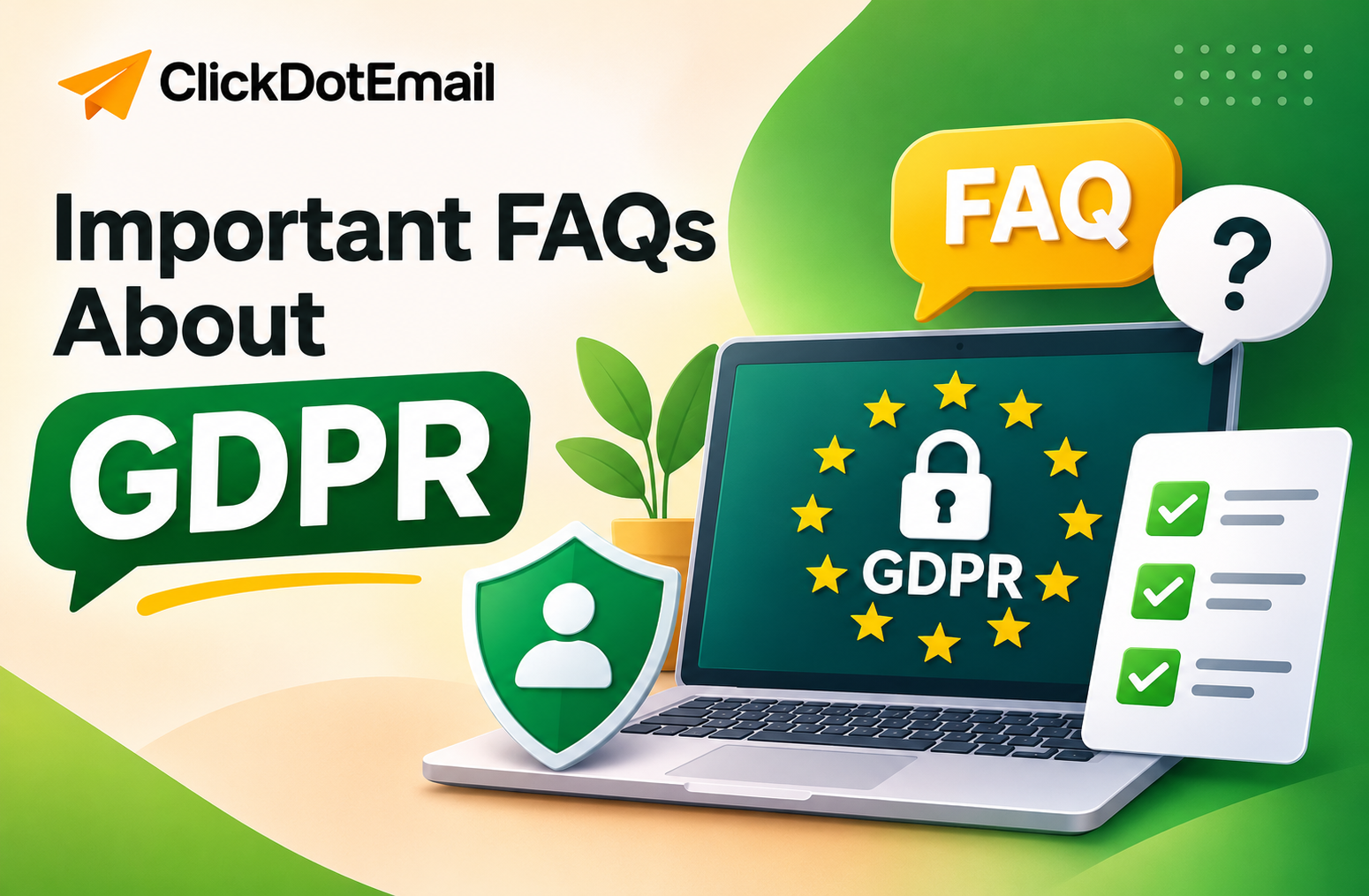
The General Data Protection Regulation (GDPR) has changed how businesses collect, store, manage, and use personal information. For companies involved in B2B marketing, lead generation, and email campaigns, understanding these regulations is essential.
Whether you run a marketing agency, manage an outbound sales team, or operate an email marketing platform, GDPR can affect how you build contact lists, communicate with prospects, and handle customer information.
However, GDPR is often misunderstood, particularly when it comes to cold emailing, business contact databases, and email marketing consent.
In this guide, we answer some of the most important GDPR FAQs to help businesses understand their responsibilities and adopt better data protection practices.
1. What Is GDPR?
GDPR stands for General Data Protection Regulation. It is a data protection law introduced by the European Union (EU) that came into effect on 25 May 2018.
Its primary purpose is to protect individuals’ personal information and give them greater control over how organisations collect, process, store, and share their data.
GDPR applies to various types of personal information, including:
- Names and surnames.
- Personal and business email addresses that identify individuals.
- Phone numbers.
- IP addresses.
- Location information.
- Other information that can identify an individual.
For email marketers, this means that collecting someone’s email address, adding it to a marketing database, and using it in an email campaign can all involve processing personal data under GDPR.
2. Does GDPR Apply to Businesses Outside the European Union?
Yes. GDPR can apply to businesses located outside the EU, including companies operating in the United States, India, the United Kingdom, and other countries.
A business generally falls within GDPR’s territorial scope if:
- It has an establishment in the EU and processes personal data in the context of its activities, regardless of where the processing takes place.
- It is located outside the EU but offers goods or services to individuals in the EU.
- It monitors the behaviour of individuals within the EU, where that behaviour takes place in the EU.
For example, an Indian email marketing agency running campaigns targeting individuals in Germany or France may need to comply with GDPR, depending on its activities and the circumstances of the processing.
GDPR is not limited to European companies or EU citizens. Its application depends on the regulation’s territorial requirements and the individuals whose data is being processed.
3. What Is Personal Data Under GDPR?
Personal data refers to any information relating to an identified or identifiable living individual.
In B2B email marketing, this distinction is particularly important.
Consider these examples:
john.smith@company.com– Personal data because it identifies an individual.marketing@company.com– Generally not personal data if it does not identify a specific individual.sales@company.com– Generally a generic business contact address.- A prospect’s name, job title, company, and direct business email – Personal data when they identify an individual.
An important point is that using a business email address does not automatically place that information outside GDPR.
If the address identifies a particular employee or professional, it can still qualify as personal data.
4. Does GDPR Require Consent Before Sending Marketing Emails?
Not necessarily in every situation. This is one of the most frequently misunderstood aspects of GDPR.
GDPR provides several lawful bases for processing personal data, including:
- Consent.
- Contractual necessity.
- Legal obligation.
- Vital interests.
- Public task.
- Legitimate interests.
For certain B2B marketing activities, legitimate interests may be an appropriate lawful basis, provided the business can demonstrate that its interests are not overridden by the individual’s rights and freedoms.
However, there is an important distinction between having a lawful basis under GDPR and having permission to send an email under electronic marketing laws.
The EU ePrivacy Directive, together with national laws implementing it, generally requires prior consent for unsolicited direct marketing emails sent to individual subscribers, subject to specific exceptions.
For example, an existing customer may sometimes receive marketing emails about similar products or services under the existing-customer exception, provided the applicable conditions are satisfied.
Therefore, businesses should not assume that legitimate interests automatically permit unsolicited marketing emails.
Before launching a campaign, check the electronic marketing rules applicable in the recipient’s country.
5. Is Cold Emailing Legal Under GDPR?
Cold emailing is not automatically illegal under GDPR. However, that does not mean every cold email campaign is permitted.
The legality depends on several factors, including:
- Whether the recipient’s information is personal data.
- Whether the business has a valid lawful basis for processing that information.
- Whether applicable ePrivacy and national marketing laws permit the email.
- Whether the recipient has been properly informed.
- Whether the recipient has previously objected to marketing communications.
For example, a B2B sales agency identifying a relevant business prospect and researching publicly available professional contact information must still assess whether its intended processing is lawful.
Public availability does not mean unrestricted permission to use someone’s personal information.
Best practice: Before sending cold emails, understand the recipient’s country-specific marketing requirements, document your legal basis where applicable, and maintain a process for handling objections and opt-outs.
6. Can Businesses Use Purchased or Third-Party Email Lists?
Using purchased email lists requires particular caution.
A vendor claiming that a contact database is GDPR-compliant does not automatically make the database lawful for your marketing activities.
Before purchasing or using a third-party contact list, businesses should establish:
- How the contact information was collected.
- Whether the original collection complied with applicable data protection laws.
- Whether the individuals were informed about the intended use of their information.
- Whether the data can legally be shared with your organisation for its own marketing.
- Whether recipients have previously objected to marketing.
For example, if a company collects email addresses based on consent, that consent must cover the relevant sharing and marketing purposes where required.
You should also ensure that your database is current and that individuals who have objected are excluded from future marketing activities.
Buying a database is not a substitute for obtaining the necessary permissions or establishing a lawful basis.
7. What Rights Do Individuals Have Under GDPR?
GDPR gives individuals several rights concerning their personal information.
These include:
Right to access: Individuals can request information about whether their personal data is being processed and obtain access to that information.
Right to rectification: They can request corrections to inaccurate or incomplete personal information.
Right to erasure: In certain circumstances, individuals can request the deletion of their personal data.
Right to data portability: They can request their personal data in a structured, commonly used, machine-readable format in qualifying situations.
Right to restrict processing: They can request restrictions on how their information is processed in certain circumstances.
Right to object: Individuals can object to certain types of processing, including processing for direct marketing.
For email marketers, the right to object is particularly important. When someone objects to the processing of their personal data for direct marketing, the business must stop using that information for that purpose.
8. What Happens If Someone Unsubscribes From Marketing Emails?
Unsubscribe requests must be taken seriously.
If a recipient opts out of your marketing emails, you must stop sending them further marketing communications covered by that objection.
Businesses should maintain a suppression list containing email addresses that have opted out. This helps prevent accidentally re-adding those contacts to future campaigns.
A good unsubscribe process should:
- Make the unsubscribe option easy to find.
- Process requests promptly.
- Avoid unnecessary steps or additional information requests.
- Ensure unsubscribed contacts are excluded from future campaigns.
- Keep sufficient suppression information to prevent accidental re-contact.
Deleting an unsubscribed contact completely from every system without retaining any suppression mechanism can create problems if the same address is imported again later.
9. What Are the Penalties for Violating GDPR?
GDPR provides significant financial penalties for organisations that fail to meet its requirements.
Depending on the nature and severity of the violation, administrative fines can reach:
- Up to €10 million or 2% of the organisation’s total worldwide annual turnover from the preceding financial year, whichever is higher, for certain infringements.
- Up to €20 million or 4% of worldwide annual turnover, whichever is higher, for more serious infringements.
These are maximum statutory limits, not automatic penalties for every violation.
Regulators consider several factors when determining fines, including the nature of the infringement, its duration, the number of individuals affected, and the organisation’s level of responsibility.
Apart from financial penalties, non-compliance can damage customer trust, business relationships, and brand reputation.
10. How Can Businesses Maintain GDPR Compliance in Email Marketing?
GDPR compliance should be part of your regular email marketing operations rather than something you consider only when a complaint arises.
Here are some practical steps businesses can follow:
- Understand your audience: Identify where your recipients are located and which data protection and electronic marketing rules apply.
- Collect information responsibly: Use transparent and lawful methods to obtain contact information.
- Document your lawful basis: Record the reason for processing personal data and maintain supporting assessments where necessary.
- Maintain accurate contact databases: Regularly review your contact information and remove outdated or unnecessary records.
- Respect unsubscribe requests: Maintain suppression lists and ensure opt-outs are applied across relevant campaigns.
- Protect personal information: Use appropriate security measures, restrict access, and establish data retention policies.
- Work with reliable service providers: Review how email marketing platforms and other third-party providers process and protect your data.
- Review your privacy policies: Clearly explain what information you collect, why you collect it, how it is used, and what rights individuals have.
For agencies and businesses managing multiple email campaigns, these practices should be consistently followed across clients, databases, and sending operations.
Final Thoughts
GDPR compliance is an important responsibility for every business involved in collecting and processing personal information.
For B2B email marketers and lead-generation companies, the biggest challenge is understanding the difference between processing business contact information, establishing a lawful basis, and complying with country-specific email marketing rules.
A business email address is not automatically exempt from data protection requirements, and publicly available contact information does not automatically qualify for unrestricted marketing use.
By maintaining transparent data practices, respecting recipient preferences, and understanding applicable regulations, businesses can build more responsible and sustainable email marketing operations.
At ClickDotEmail, we believe effective email marketing starts with responsible sending practices, reliable infrastructure, and well-managed contact databases.